
- Solution
- Trade Database
- Global
-
RCEP
- Australia Statistics
- China Statistics
- Indonesia
- Indonesia Order
- Indonesia Statistics
- Japan Importer/Exporter
- Japan Statistics
- Malaysia
- New Zealand Statistics
- Philippine
- RCEP-15 Mirror
- South Korea Import B/L
- South Korea Importer/Exporter
- South Korea Statistics
- Thailand Importer/Exporter
- Thailand Statistics
- Vietnam(VNGD)
- Asia
-
Europe
- Armenia
- Belgium Statistics
- British Importer/Exporter
- EU-27 Mirror
- EU-27 Statistics
- France Statistics
- Germany Statistics
- Italy Statistics
- Kosovo, Serbia
- Moldova
- Netherlands Statistics
- Poland Statistics
- Russia
- Russian Railway
- Russian Railway Domestic Trade
- Russian Railway Transit
- Spanish Importer/Exporter
- Sweden Statistics
- Turkey
- Turkey Order
- Turkey Transit
- Ukraine
- Ukraine Adv
- United Kingdom Statistics
-
America
- Argentina
- Bolivia
- Brazil
- Brazil B/L
- Brazil Statistics
- Chile
- Chile New
- Colombia
- Costa Rica
- Dominican
- Ecuador
- Guatemala
- Guyana
- Mexico (Air)
- Mexico (All Transportation)
- Mexico (Maritime)
- Nicaragua
- Nicaragua Weekly
- Panama
- Paraguay
- Peru
- Peru B/L (Air + Sea)
- Uruguay
- US B/L (Daily)
- US B/L (Weekly)
- Venezuela
- Venezuela Bills
- Africa
- Media
- Contact Intelligence
- Get a Trial
Please Sign in to view recently saved searches
Africa-4 Mirror Data
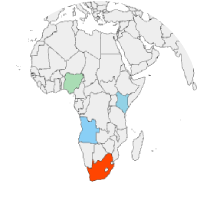
Africa-4 Mirror Data covers four key African markets: South Africa, Kenya, Nigeria, and Angola.
1. South Africa
South Africa is the largest economy in Africa. According to World Bank data, South Africa’s GDP growth rates were 5.0% in 2021, 1.9% in 2022, 0.7% in 2023, and 0.6% in 2024.
1.1 Mineral Resources
South Africa is one of the world’s leading mineral resource countries, known for its wide variety of minerals, large reserves, and high production output. It possesses one of the world’s richest mineral geological structures. More than 70 minerals have been discovered and mined, with an estimated total value of approximately USD 2.5 trillion.
South Africa ranks among the world leaders in reserves, production, and exports of platinum group metals (PGMs), manganese ore, chromium ore, alumino-silicates, gold, diamonds, fluorspar, vanadium, vermiculite, zirconium ores, and titanium ores. Some of these account for more than 50% of global reserves or output.
1.2 South Africa Agricultural Resources
South Africa is one of Africa’s leading agricultural economies, with the highest commercialization rate of agricultural products on the continent. Major agricultural products include corn, wheat, sugar cane, sunflower, poultry eggs, beef, dairy products, mutton, and wool.
In 2024, agriculture accounted for approximately 2.9% of GDP. Agriculture is export-oriented, with agricultural exports reaching USD 14.33 billion in 2024, accounting for 12.9% of total exports.
Major export destinations include the Netherlands, Zimbabwe, the United Kingdom, Botswana, Namibia, and China. Key export products include citrus fruits, grapes, corn, apples, wine, and nuts.
South Africa is one of the world’s six major wine-producing regions. According to Wines of South Africa (WOSA), wine exports reached 306 million liters in 2024, valued at approximately USD 562 million (around ZAR 10.3 billion).
According to Agbiz, South Africa’s agricultural exports hit a record USD 13.7 billion in 2024. Of these exports, 44% went to other African countries, 21% to Asia and the Middle East, 19% to the European Union, and 6% to the Americas.
1.3 South Africa Manufacturing Industry
South Africa has a well-developed and technologically advanced manufacturing sector, covering steel, metal products, chemicals, transportation equipment, machinery manufacturing, food processing, textiles, and apparel.
South Africa is also one of the world’s major automotive manufacturing and trading hubs. Global automotive companies including BMW, Daimler-Chrysler, Volkswagen, Toyota, and Ford have established production facilities in the country.
According to the South African Revenue Service (SARS), exports of vehicles and transportation equipment reached USD 15.09 billion in 2024.
1.4 South Africa Trade Agreements
South Africa is a founding member of the World Trade Organization (WTO) and is often the preferred gateway for countries seeking trade agreements with Africa due to its regional influence across Southern Africa.
1.4.1. Southern African Customs Union (SACU)
Established in 1910 and revised in 1969 and 2002, SACU includes South Africa, Botswana, Lesotho, Namibia, and Eswatini. All goods traded within the union are exempt from customs duties.
1.4.2. Southern African Development Community (SADC)
Originally established as the Southern African Development Coordination Conference (SADCC), SADC was reorganized in 1992 and currently has 16 member states.
In 2008, SADC launched a Free Trade Area (FTA), eliminating tariffs on approximately 85% of imports traded among member states while applying common external tariffs to non-member countries.
1.4.3. SADC-EU Economic Partnership Agreement (EPA)
The EU granted South Africa additional tariff quotas for wine and sugar and recognized geographical indications such as Rooibos tea.
Under the agreement, 98.7% of South African products can enter the EU duty-free, while South Africa only needs to eliminate tariffs on 86% of EU goods.
1.4.4. African Continental Free Trade Area (AfCFTA)
AfCFTA officially launched on January 1, 2021, marking a major milestone in Africa’s regional integration and economic transformation.
In January 2024, South Africa shipped its first AfCFTA preferential trade exports from Durban Port.
As of January 2025, 54 out of 55 African Union member states had signed the agreement, with 48 countries having ratified it.
1.5 South Africa Foreign Trade
According to preliminary data, South Africa recorded a trade surplus of ZAR 201.6 billion in 2025, higher than the ZAR 197.1 billion surplus recorded in 2024.
Exports in December 2025 reached ZAR 164.3 billion, up 3.4% year-on-year, while imports fell 2.2% to ZAR 141.1 billion.
South Africa’s major exports remain gold, PGMs, coal, vehicles, and automotive parts. Main imports include crude oil, petroleum products, machinery, automotive components, and electronics.
In 2024, South Africa’s total merchandise trade reached USD 212.2 billion, down 2.6% year-on-year.
Major trading partners include China, Germany, the United States, India, and Mozambique.
Key exports include gold, ores, vehicles and parts, mineral fuels, steel, machinery, fruits, and nuts. Main imports include petroleum, machinery, electrical equipment, vehicles, plastics, and pharmaceuticals.
2. Nigeria
Nigeria is located in West Africa and plays a dominant role in the regional economy. Its GDP accounts for more than three-quarters of the total GDP of ECOWAS countries. Nigeria is also Africa’s most populous country and one of the continent’s largest economies.
Nigeria serves as the headquarters of the Economic Community of West African States (ECOWAS) and has strong economic influence across West Africa and the broader African market.
2.1 Nigeria Trade Agreements
Nigeria joined the WTO in 1995 as a founding member.
Nigeria is also an original participant in the Generalized System of Preferences (GSP).
Regionally, Nigeria is a member of the African Union (AU) and ECOWAS.
On July 7, 2019, Nigeria signed the African Continental Free Trade Agreement (AfCFTA).
2.2 Nigeria Foreign Trade
2.2.1 2025 Overview
Nigeria recorded a trade surplus of NGN 17.78 trillion in 2025, with exports worth NGN 85.13 trillion exceeding imports of NGN 67.35 trillion.
Total foreign trade reached NGN 152.47 trillion in 2025, up from NGN 138.03 trillion in 2024, according to the National Bureau of Statistics (NBS).
Oil remained Nigeria’s largest export product. Crude oil exports were valued at NGN 47.43 trillion, accounting for 55.72% of export earnings.
2.2.2 2024 Overview
According to NBS data, Nigeria’s total foreign trade reached NGN 138.03 trillion in 2024, a year-on-year increase of 106.56%.
Exports totaled NGN 77.44 trillion, while imports reached NGN 60.59 trillion, resulting in a trade surplus of NGN 16.85 trillion.
2.2.2.1 Trade Partners
Nigeria’s top export destinations in 2024 were Spain, France, the Netherlands, India, and the United States.
Major import sources were China, Belgium, India, the United States, and the Netherlands.
2.2.2.2 Trade Structure
Nigeria’s trade structure remains highly dependent on crude oil and natural gas exports.
Major imports include machinery, petroleum products, transportation equipment, chemicals, food products, plastics, rubber products, and agricultural products.
3. Kenya
Kenya is recognized as Africa’s second-largest luxury goods consumption market and one of the continent’s most promising private banking markets.
Kenya is also one of the fastest-growing economies in East Africa.
3.1 Cultural Characteristics
Due to its unique geographical location and historical background, Kenya has developed into a multicultural society influenced by Swahili, Western, Islamic, and Indian cultures.
British influence remains strong in social etiquette, business customs, dress codes, and dining culture.
3.2 Kenya Trade Agreements
Kenya is a founding member of the WTO.
3.2.1. Regional Trade Agreements
Kenya is a key member of both the Common Market for Eastern and Southern Africa (COMESA) and the East African Community (EAC).
Member states enjoy preferential tariff treatment in trade, finance, transportation, agriculture, energy, and legal cooperation.
In October 2000, Kenya and eight COMESA members signed the first Free Trade Area agreement implementing zero tariffs.
3.2.2. Double Taxation Agreements
Kenya has signed double taxation agreements with 18 countries, including the UK, Sweden, India, Denmark, Norway, Zambia, France, Germany, and Canada.
3.2.3. WTO Generalized System of Preferences (GSP)
Kenyan processed products enjoy preferential tariff treatment in the United States, Japan, Canada, Switzerland, Norway, Sweden, Finland, Australia, New Zealand, and most European countries.
More than 3,000 export products benefit from GSP treatment without quantity restrictions.
3.2.4. Kenya-EU Economic Partnership Agreement (EPA)
The Kenya-EU EPA was officially signed on December 18, 2023.
The agreement grants Kenyan products duty-free and quota-free access to the EU market and includes WTO-related rules addressing unfair trade and dumping practices.
3.3 Kenya Foreign Trade
3.3.1 2025 Foreign Trade
Kenya’s exports in 2025 continued to rely heavily on agricultural products, particularly tea, horticultural products, coffee, and flowers.
Kenyan flowers remain highly competitive in the European market.
Main imports include petroleum products, machinery, vehicles, pharmaceuticals, and electronics.
3.3.2 2024 Foreign Trade
In 2024, Kenya’s total merchandise trade increased 5.5% year-on-year to KES 3.82 trillion.
Exports rose 10.4% to KES 1.11 trillion, while imports increased 3.6% to KES 2.71 trillion.
The trade deficit narrowed slightly from KES 1.60 trillion in 2023 to KES 1.59 trillion in 2024.
According to the Kenya Economic Survey 2025, export growth was driven mainly by horticultural products, apparel, vegetable and animal oils, and metal scrap.
Traditional exports such as horticultural products, tea, apparel, and unroasted coffee accounted for 52.4% of export earnings in 2024.
Africa accounted for 38.3% of Kenya’s exports, with major African destinations including Uganda, Tanzania, Rwanda, the Democratic Republic of the Congo, South Sudan, and Egypt.
Major Asian export markets include the UAE, Pakistan, Saudi Arabia, China, and India.
The EU and the United States also remain key export destinations.
Kenya’s imports increased mainly due to higher imports of industrial machinery, aircraft equipment, plastics, rice, petroleum products, steel, and motor vehicles.
Asia remained Kenya’s largest import source, accounting for 66.4% of total imports.
China supplied machinery and transportation equipment, Pakistan exported rice, Malaysia supplied palm oil, and Oman provided aviation fuel.
Kenya also imports fertilizers from Russia and wheat, peas, and maize flour from Ukraine.
Major trading partners in 2024 included China, the UAE, India, the United States, Uganda, and Malaysia.
4. Angola
Angola is a member of the WTO and officially ratified AfCFTA in 2020.
The country also participates in regional organizations including SADC, the Economic Community of Central African States (CEEAC), the Gulf of Guinea Commission, the Community of Portuguese Language Countries (CPLP), and the African Petroleum Producers’ Organization.
Angola is a typical oil-dependent economy, with exports heavily reliant on crude oil.
Main imports include fuel, machinery, construction materials, food products, vehicles, and spare parts.
Its regional trade influence is mainly concentrated within SADC and CEEAC member states.
4.1 Angola Foreign Trade
4.1.1 2025 Foreign Trade
In 2025, Angola’s exports totaled approximately 28 trillion kwanza, down around 11.5% year-on-year.
Imports reached approximately 15.3 trillion kwanza, up 16.9%.
The annual trade surplus fell to approximately 12.8 trillion kwanza, down more than 30% from 2024.
Crude oil continued to account for over 90% of Angola’s exports.
China remained Angola’s largest export destination, accounting for around 47% of exports, followed by India and Indonesia.
Diamond exports also increased significantly due to the launch of the Luele mine.
Major imports included machinery, vehicles, food products, pharmaceuticals, and industrial goods.
4.1.2 2024 Foreign Trade
In 2024, Angola’s total merchandise trade reached USD 50.98 billion.
Exports totaled USD 36.79 billion, with major destinations including China, India, Spain, Indonesia, France, and the UAE.
Key exports included crude oil, diamonds, mineral products, agricultural products, and grains.
Imports totaled USD 14.19 billion.
Major import sources included China, Portugal, the UK, India, the United States, South Korea, Brazil, and the UAE.
Key imports included machinery, fuel, food products, construction materials, chemicals, vehicles, and spare parts.
5. Blooming’s Africa-4 Mirror Data
Blooming’s Africa-4 Mirror Data is continuously updated to provide timely and reliable trade intelligence across South Africa, Kenya, Nigeria, and Angola.
The database helps users identify active importers and exporters, monitor market trends, analyze trade flows, discover new business opportunities, and better understand the trade landscape across key African markets.
With comprehensive customs and mirror trade data coverage, Blooming supports businesses in market expansion, customer development, competitor analysis, and strategic decision-making in Africa.
Explore Africa’s fast-growing markets with Blooming’s Africa-4 Mirror Data covering South Africa, Kenya, Nigeria, and Angola. Apply for a free trial today to access reliable import-export insights, active buyers, and market opportunities.
Sample Data
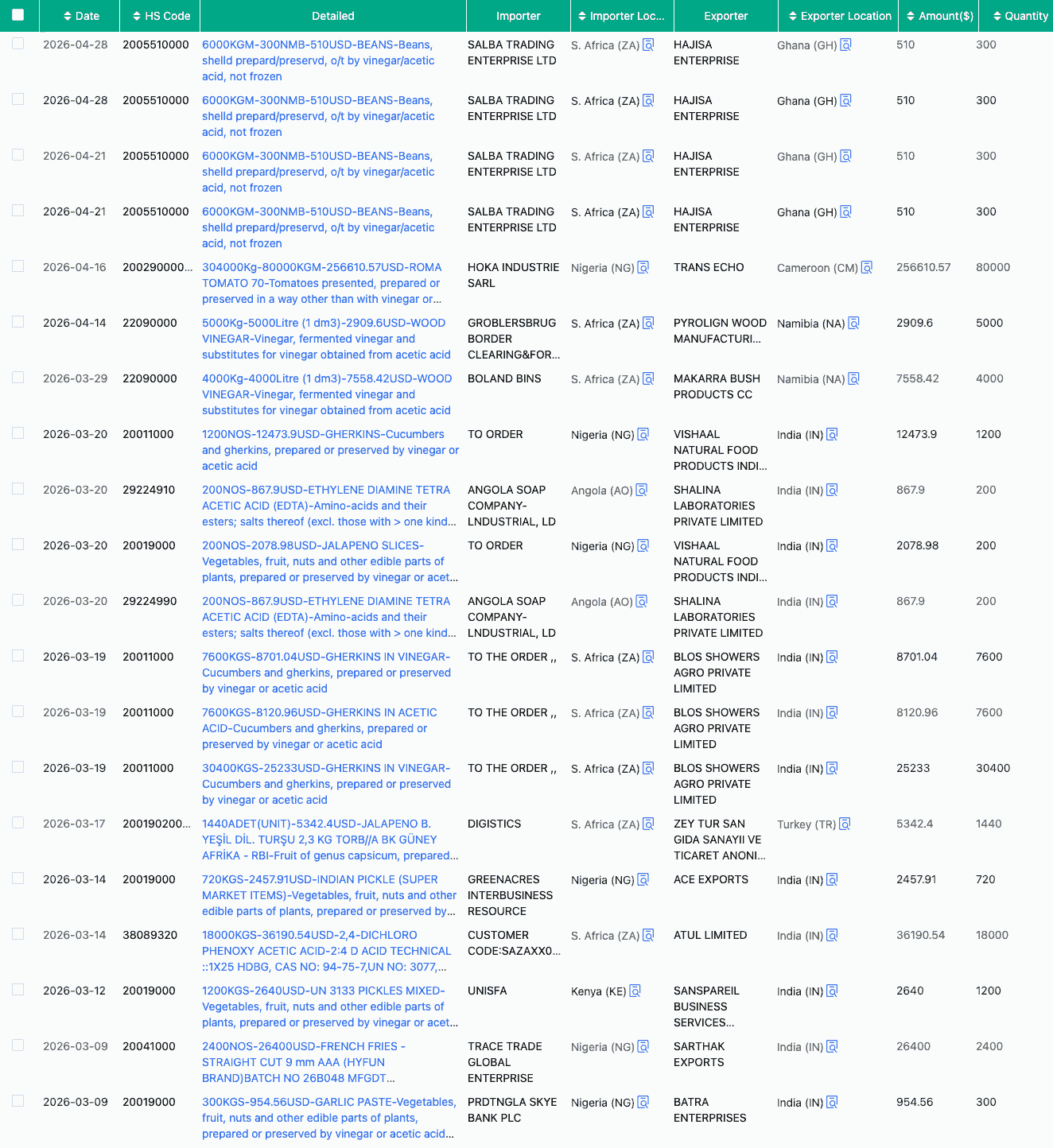

Unlock trade intelligence across four key African economies with continuously updated mirror trade data. Request a demo today and discover new customers, monitor competitors, and identify high-potential markets faster.