
- Solution
- Trade Database
- Global
-
RCEP
- Australia Statistics
- China Statistics
- Indonesia
- Indonesia Order
- Indonesia Statistics
- Japan Importer/Exporter
- Japan Statistics
- Malaysia
- New Zealand Statistics
- Philippine
- RCEP-15 Mirror
- South Korea Import B/L
- South Korea Importer/Exporter
- South Korea Statistics
- Thailand Importer/Exporter
- Thailand Statistics
- Vietnam(VNGD)
- Asia
-
Europe
- Armenia
- British Importer/Exporter
- EU-27 Mirror
- EU-27 Statistics
- France Statistics
- Germany Statistics
- Italy Statistics
- Kosovo, Serbia
- Moldova
- Russia
- Russian Railway
- Russian Railway Domestic Trade
- Russian Railway Transit
- Spanish Importer/Exporter
- Turkey
- Turkey Order
- Turkey Transit
- Ukraine
- Ukraine Adv
- United Kingdom Statistics
- America
- Africa
- Media
- Contact Intelligence
- Get a Trial
Please Sign in to view recently saved searches
Special Economic Zones (SEZs) in India
As one of the BRICS countries, India has experienced rapid economic growth in recent decades. The establishment and expansion of Special Economic Zones (SEZs) have been a key driver of this growth.
India began developing export-oriented industrial zones as early as 1956, with the establishment of the Kandla Export Processing Zone (EPZ) in Gujarat, covering an area of only 700 mu (approximately 47 hectares). Since then, the number of export processing zones expanded rapidly. By 1975, India had 79 EPZs across 25 states; by 1986, this number had grown to 176 EPZs across 47 states. In 1997, India had 845 EPZs covering 93 states, and by 2000, the number had exceeded 3,000 zones across 116 states, employing nearly 89,000 people.
After 2000, following studies of SEZ development in China and other countries, India decided to integrate and regulate existing export development zones through national legislation. These zones were officially renamed Special Economic Zones (SEZs), marking a new phase in India's SEZ development. SEZs have since played a significant role in attracting investment, boosting exports, expanding employment, and driving India's overall economic growth.
Institutional and Legal Framework
In January 2003, four remaining government-owned export processing zones-Falta, Noida, Visakhapatnam, among others-were upgraded to SEZs, completing the transition of all seven major state-owned EPZs into SEZs. As SEZs expanded nationwide, supporting legal and regulatory frameworks were gradually established.
In 2004, Gujarat became the first Indian state to pass SEZ-related legislation. In May 2005, the Indian Parliament enacted the country's first nationwide SEZ legislation, the Special Economic Zones Act (SEZ Act). The Act established comprehensive rules covering approval procedures, entry requirements, institutional structures, and tax incentives, providing a solid legal foundation for SEZ development.
In February 2006, the Indian government issued the SEZ Rules, further refining the regulatory framework. That same year, the Board of Approval (BOA), the sole official authority responsible for SEZ approvals, began operations, triggering rapid growth in SEZ development across India.
By June 2007, 303 SEZs had received formal approval, 127 had commenced operations, and 161 had obtained in-principle approval. The total planned SEZ area reached 1,845 square kilometers, with cumulative investment of USD 68.18 billion.
Expansion and Current Status of SEZs
By 2010, India had approved 578 SEZs, with 348 officially notified and 105 operational. With continuous improvements in policies and regulations, SEZs entered a phase of accelerated expansion.
By 2020, the total number of SEZs had expanded to 406. As of March 31, 2025, India had 280 operational SEZs. Since the enactment of the SEZ Act in 2005, approximately 423 SEZs have been approved, of which 280 are currently in operation.
Tamil Nadu leads with 60 approved SEZs, 49 of which are operational. Telangana follows with 60 approved and 37 operational SEZs, while Karnataka has 61 approved and 38 operational SEZs. Maharashtra ranks fourth, with 47 approved SEZs and 36 operational ones.
Share of SEZs in India's Imports and Exports
In 1970, exports from India's export processing zones accounted for only 0.02% of national exports, while imports represented 0.03%. By 1980, these shares had risen to 0.22% and 0.67%, respectively. In 1985, export and import shares further increased to 3.05% and 1.02%. During 2007–2008, exports generated by SEZ enterprises accounted for approximately 10% of India's total exports.
According to government data, SEZ exports in 2009–2010 were expected to exceed INR 900 billion, roughly equivalent to the total annual exports of SEZ enterprises in 2009.
By 2020, SEZ exports accounted for 26% of India's total exports. A special report released by India's Ministry of Commerce and Industry in 2023 showed that 274 operational SEZs contributed approximately 12% of national merchandise exports, up from just 5% in 2015.
From a GDP perspective, the economic output of SEZs increased steadily from 4.6% of national GDP in 2010 to 8.3% in 2022, with a compound annual growth rate (CAGR) of 9.8%, significantly exceeding India's overall GDP growth rate of 5.4% during the same period.
Industry Structure and Economic Impact
The economic contribution of SEZs varies significantly by industry. Electronics manufacturing SEZs have demonstrated the strongest GDP impact. The Noida SEZ alone recorded annual output of INR 420 billion, accounting for 15% of Uttar Pradesh's industrial output.
Pharmaceutical SEZs exhibit higher value-added characteristics. The Hyderabad pharmaceutical cluster, representing only 7% of the country's pharmaceutical enterprises, contributed 32% of India's active pharmaceutical ingredient (API) exports. In the services sector, fintech-focused SEZs boosted the share of financial services in Mumbai's GDP from 6.2% in 2015 to 9.1% in 2022.
This structural optimization has led to an average annual growth of total factor productivity (TFP) in SEZs of 3.2%, exceeding non-SEZ regions by 1.8 percentage points. According to the Reserve Bank of India, with the continued implementation of the Production-Linked Incentive (PLI) scheme, SEZ exports are expected to reach USD 350 billion by 2026.
Recent Performance (FY 2024–25)
In fiscal year 2024–25 (April 2024 to March 2025), SEZ exports reached USD 172.27 billion, up from USD 163.69 billion in the previous fiscal year, accounting for approximately 37% of India's total merchandise exports.
As of June 30, 2025, 276 SEZs were operational, primarily concentrated in Tamil Nadu, Maharashtra, and Karnataka, contributing more than 38% of India's total merchandise exports.
Blooming India SEZ Trade Data
Blooming India SEZ Trade Data provides continuously updated insights into India's SEZ-related trade activities. The dataset covers buyer information, seller information, product details, logistics and shipment data (including domestic and overseas ports), trade values (USD and INR), trade volume, quantities, and unit prices.
This data helps identify the fastest-growing export industries within SEZs, recognize high-frequency purchasing enterprises (long-term buyers), and support the development of targeted sales and channel strategies focused on SEZs. It also enables users to identify cost-competitive SEZ suppliers and assess whether specific products have stable, scalable export capacity.
Beyond export scale, Blooming India SEZ Trade Data helps identify enterprises and industries with genuine international competitiveness, making it a valuable tool for analyzing India's manufacturing export orientation, supply chain configuration, and emerging market opportunities.
Do you want to identify which industries within India’s SEZs are experiencing the fastest export growth? Are you looking to uncover high-frequency buyers inside SEZs and identify more cost-competitive suppliers with proven export capabilities?

Sample Data
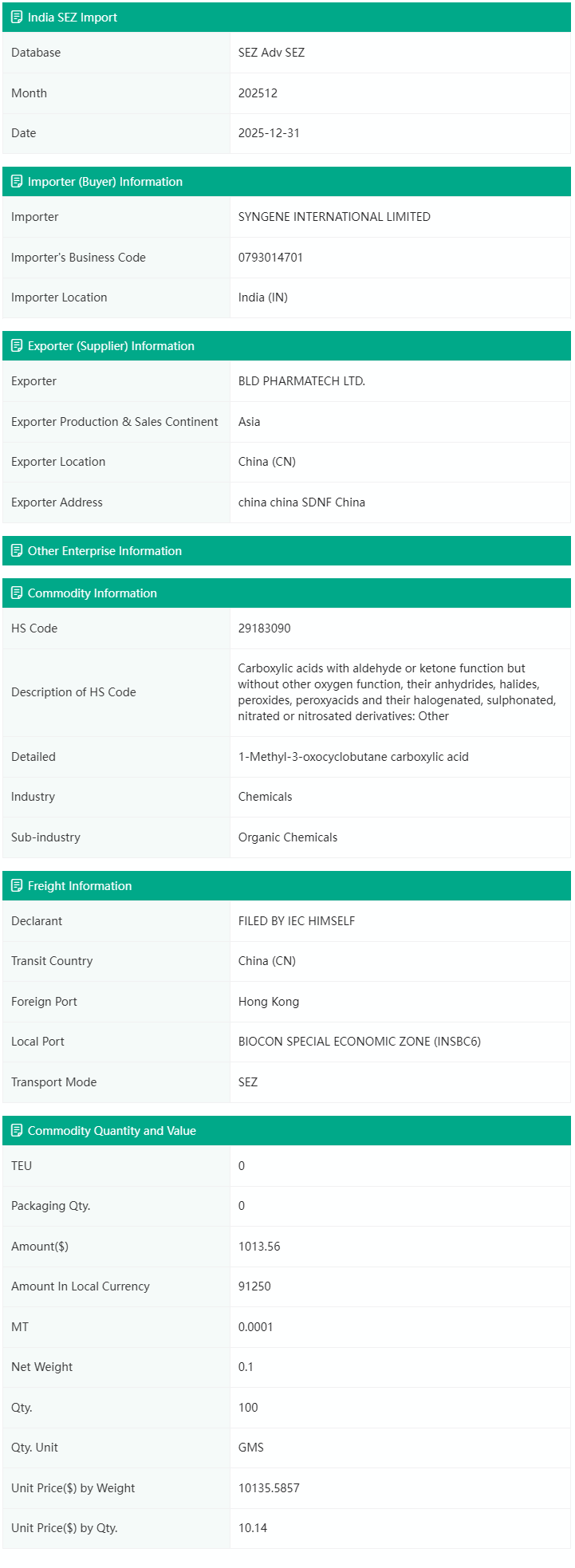

Schedule a demo to see how real India SEZ trade data reveals fast-growing export sectors, recurring buyers, and competitive suppliers. You can also start a free trial to explore SEZ buyers, products, and trade flows firsthand.