
- Solution
- Trade Database
- Global
-
RCEP
- Australia Statistics
- China Statistics
- Indonesia
- Indonesia Order
- Indonesia Statistics
- Japan Importer/Exporter
- Japan Statistics
- Malaysia
- New Zealand Statistics
- Philippine
- RCEP-15 Mirror
- South Korea Import B/L
- South Korea Importer/Exporter
- South Korea Statistics
- Thailand Importer/Exporter
- Thailand Statistics
- Vietnam(VNGD)
- Asia
-
Europe
- Armenia
- British Importer/Exporter
- EU-27 Mirror
- EU-27 Statistics
- France Statistics
- Germany Statistics
- Italy Statistics
- Kosovo, Serbia
- Moldova
- Russia
- Russian Railway
- Russian Railway Domestic Trade
- Russian Railway Transit
- Spanish Importer/Exporter
- Turkey
- Turkey Order
- Turkey Transit
- Ukraine
- Ukraine Adv
- United Kingdom Statistics
- America
- Africa
- Media
- Contact Intelligence
- Get a Trial
Please Sign in to view recently saved searches
Eurasian Economic Union (EAEU)
The Eurasian Economic Union (EAEU), also known as the Eurasian Economic Commission, is a regional international economic organization established on January 1, 2015, pursuant to the Treaty on the Eurasian Economic Union, originally signed by Russia, Belarus, and Kazakhstan.
The EAEU aims to create a single economic space through the elimination of trade barriers and the coordination of economic policies, enabling the free movement of goods, services, capital, and labor. The Union planned to achieve full factor mobility by 2025.
The founding member states are Russia, Belarus, and Kazakhstan, later expanded to include Armenia (January 2, 2015) and Kyrgyzstan (August 12, 2015).
Observer states include Uzbekistan, Cuba, and Moldova.
Kazakhstan is scheduled to assume the rotating presidency of the EAEU in 2026.
Treaty Signing
On May 29, 2014, Russian President Vladimir Putin, Belarusian President Alexander Lukashenko, and Kazakh President Nursultan Nazarbayev signed the Treaty on the Eurasian Economic Union in Astana, the capital of Kazakhstan.
Under the Treaty, the EAEU officially commenced operations on January 1, 2015. By 2025, Russia, Belarus, and Kazakhstan committed to achieving the free movement of goods, services, capital, and labor. The ultimate objective is to establish an economic union similar to the European Union, forming a unified market of approximately 170 million people.
The Treaty covers a wide range of areas, including energy, transport, industry, agriculture, customs, trade, taxation, and government procurement. It also includes a list of goods eligible for free trade, excluding sensitive products such as tobacco and alcohol.
The EAEU is defined as an international organization, in which Russia, Belarus, and Kazakhstan enjoy equal rights and voting power within EAEU institutions. Unlike the EU's eurozone, the member states have never discussed adopting a single currency. Each member retains its independent monetary policy, and the Union explicitly does not pursue a unified currency system.
Free Trade Agreements and External Relations
The EAEU has signed free trade or preferential trade agreements with Vietnam, Singapore, Serbia, and Iran, and is advancing negotiations with Egypt, India, and Israel.
In December 2024, the EAEU reached a Comprehensive Economic Partnership Agreement (CEPA) with the United Arab Emirates.
In December 2025, the EAEU signed a Free Trade Agreement with Indonesia.
The EAEU has increasingly shifted toward settlement in national currencies, with over 93% of settlements now conducted in local currencies.
On December 25, 2023, representatives of the five EAEU member states and Iran signed a Comprehensive Free Trade Agreement, replacing the provisional trade agreement in force since 2019.
On December 11, 2020, during a meeting of the Supreme Eurasian Economic Council, EAEU member states unanimously granted observer status to Cuba and Uzbekistan.
On May 15, 2025, the EAEU–Iran Free Trade Agreement officially entered into force, significantly boosting trade between the two sides.
In June 2025, the EAEU signed a Free Trade Agreement with the United Arab Emirates and a temporary free trade agreement with Mongolia, with ratification procedures currently underway.
On December 21, 2025, the EAEU member states signed a Free Trade Agreement with Indonesia in St. Petersburg, Russia.
Integration Progress
The EAEU has approved and implemented a new Customs Code, reducing customs clearance time by half and shortening cargo clearance time to one-sixth of previous levels.
A unified services market now covers 53 economic sectors, while internal goods circulation within the Union has expanded by 32%. A single market for pharmaceuticals and medical devices has been established.
The Union decided to harmonize excise taxes on alcohol and tobacco products and approved documents to launch unified financial, transportation, and energy markets by 2025.
Since 2016, the EAEU has eliminated 51 internal barriers. To prevent new barriers, the Union works closely with member governments to ensure regulatory alignment. The EAEU has also signed an Agreement on the Trade of Precious Metals and Gemstones, with plans to promote EAEU jewelry products in third-country markets.
Cooperation with China
The EAEU has signed the China–EAEU Economic and Trade Cooperation Agreement, marking a significant step toward aligning the Union with China's Silk Road Economic Belt initiative.
Through most-favored-nation treatment, the EAEU's free trade network continues to expand, now covering approximately 22% of global GDP.
The EAEU has concluded FTAs with Vietnam, Iran, Serbia, and Singapore, and negotiations with Egypt, Israel, and India are nearing completion.
Electric Vehicle Import Duty Exemptions
Starting January 22, 2026, duty-free import quotas for electric vehicles have been introduced for Armenia, Belarus, and Kyrgyzstan:
* Belarus: 20,000 vehicles
* Armenia: 15,000 vehicles
* Kyrgyzstan: 15,000 vehicles
Restrictions:
These vehicles may only be purchased by permanent residents of the three countries and may not be transferred to residents of Kazakhstan or Russia.
2024 Trade and Economic Data
In 2024, the combined GDP of EAEU member states grew by 4%.
Intra-union trade was estimated at USD 98.3 billion, while mutual investment reached approximately USD 2 billion in the first half of the year.
Most economic indicators showed growth, with EAEU member states outperforming the global average for the second consecutive year. Driven by domestic demand, retail trade turnover increased by 7.7% year-on-year.
From January to November, industrial production grew by 4.3%.
Construction output rose by 3%, and passenger transport volume increased by 7.2%.
In the first half of 2024, 91.2% of settlements among member states were conducted in local currencies, up from 88.9% in 2023.
These measures contributed to lower unemployment and higher real wages. In the third quarter of 2024, the EAEU unemployment rate fell to 2.9%, the lowest level in the past decade.
2025 Data
In 2025, the combined GDP of EAEU member states is projected to grow by 2%, with stable growth expected over the following two years.
Since the establishment of the Union, mutual direct investment among member states has exceeded USD 20 billion.
Investment inflows into Kazakhstan increased nearly sevenfold, from USD 600 million in 2015 to USD 4 billion in 2024.
Over the same period, industrial output within the EAEU grew by 29%, reaching approximately USD 1.5 trillion.
According to experts from the Eurasian Development Bank, EAEU countries still have around USD 67 billion in untapped potential in industrial production and exports. If fully realized, the overall economic impact could reach USD 500 billion.
Future Outlook
In 2025, the signing of FTAs with Mongolia and Indonesia, as well as the Economic Partnership Agreement with the UAE, represents the tangible outcome of joint efforts by EAEU member states and the Eurasian Economic Commission.
Going forward, the EAEU plans to expand cooperation with the Global South, Arab countries, Southeast Asia, Africa, and major regional organizations. The Union is transforming from a resource-based regional economy into a more open, rules-based, and externally oriented economic cooperation platform, with deepening internal integration and an expanding external free trade network.
Blooming EAEU Trade Data
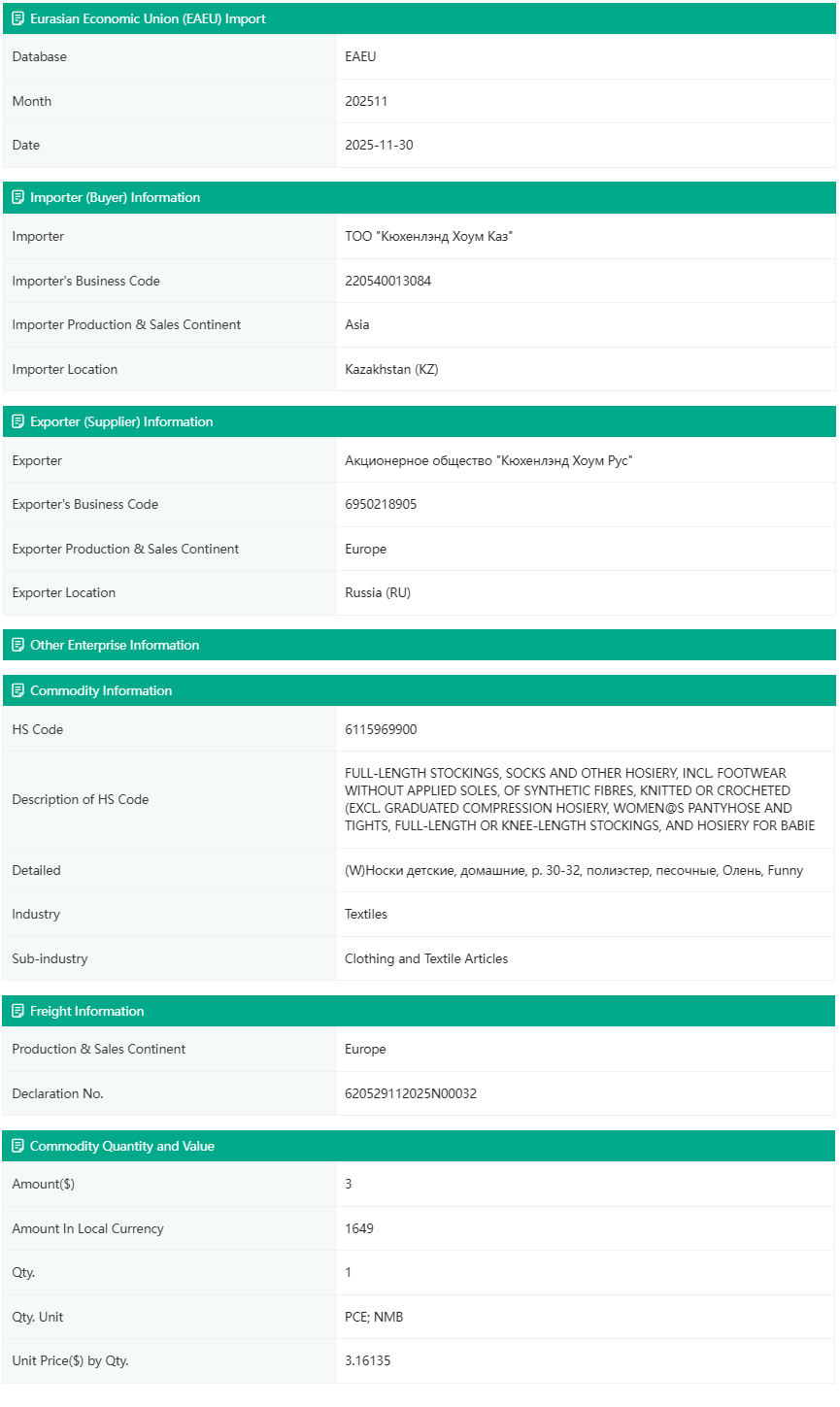
Blooming's EAEU trade data is continuously updated and provides comprehensive coverage of trade activities within EAEU member states, including:
* Importer and exporter information
* Product-level trade details
* Logistics and shipment information
* Trade value, volume, and reference prices
The EAEU covers Russia, Kazakhstan, Belarus, Armenia, and Kyrgyzstan, forming a highly integrated customs union.
Blooming's EAEU trade data helps users:
* Identify real demand for products within the Union
* Assess import dependency and substitution risks
* Discover fast-growing yet less competitive niche markets
* Identify long-term, stable importers
* Recognize companies serving as regional distributors or re-export hubs
Do you want to understand market demand in the Eurasian Economic Union (EAEU)? Are you looking to expand your business across the EAEU? Are you seeking more cooperation with clients and reliable suppliers within the EAEU?

Sample Data

Are you interested in your competitors’ activities in the Eurasian Economic Union (EAEU) market?