Asia 7 Regions Trade Overview
Asia is one of the world's most important trading regions, accounting for a significant share of global manufacturing, exports, logistics, and cross-border investment. Customs data plays a critical role in helping businesses identify trading opportunities, monitor supply chains, analyze competitors, and discover qualified buyers and suppliers.
The Asia 7 Regions covered in this report include Hong Kong SAR, Macao SAR, Taiwan Region, South Korea, North Korea, Bangladesh, and Mongolia. Together, these markets represent a diverse mix of international trade hubs, manufacturing centers, resource-exporting economies, and emerging markets.
Hong Kong is a global trade, logistics, and financial center. Macao serves as an important gateway connecting China with Portuguese-speaking countries. Taiwan and South Korea are among the world's leading technology and semiconductor manufacturing economies. Bangladesh is one of the world's largest garment-exporting countries. Mongolia is rich in mineral resources and plays an important role in Northeast Asian commodity trade. North Korea provides unique insights into a highly concentrated trading environment.
Access to customs data from these seven regions enables businesses to track import and export activities, identify active buyers and suppliers, monitor market trends, and support data-driven international expansion strategies.
Hong Kong Customs Data
Hong Kong Trade Overview
Hong Kong is one of Asia's most dynamic economies and one of the world's leading international trade and logistics centers. Benefiting from its free-port status, strategic location, world-class infrastructure, and highly open economy, Hong Kong serves as a major gateway connecting Mainland China with global markets.
According to the Census and Statistics Department of the Hong Kong Special Administrative Region Government, financial services, trading and logistics, tourism, and professional and producer services are the four pillar industries of Hong Kong's economy. As of December 2024, these sectors collectively contributed 57.1% of Hong Kong's GDP.
According to World Trade Organization statistics, Hong Kong ranked as the world's seventh-largest merchandise trading economy and the eleventh-largest commercial services trading economy in 2024.
Hong Kong Trade Statistics
Hong Kong's total merchandise trade reached HKD 9.4645 trillion (approximately USD 1.213 trillion) in 2024, representing year-on-year growth of 7.3%.
Exports totaled HKD 4.5424 trillion, increasing by 8.7%.
Imports reached HKD 4.9221 trillion, increasing by 6.0%.
The trade deficit was HKD 379.7 billion, equivalent to approximately 7.7% of total import value.
Hong Kong's major trading partners include Mainland China, ASEAN member states, the European Union, and the United States.
In addition to physical trade, Hong Kong remains one of the world's leading offshore trading centers. According to the Hong Kong Trade Development Council, offshore trade generated approximately USD 683.7 billion (HKD 5.333 trillion) in 2022.
Hong Kong Trade Performance in 2025
Despite increased global trade uncertainty and the impact of additional tariffs imposed by the United States, Hong Kong's merchandise trade remained resilient in 2025.
Between January and November 2025, total merchandise trade reached HKD 9.8 trillion, representing growth of 14.2% compared with the same period of the previous year.
Exports totaled HKD 4.7 trillion, increasing by 14.3%.
Imports reached HKD 5.1 trillion, increasing by 14.1%.
The trade deficit reached HKD 382.8 billion, equivalent to 7.5% of total imports.
The top ten export destinations accounted for 84.2% of Hong Kong's total exports. Mainland China remained the largest export market, accounting for 59.5% of exports and growing by 15.8%. Exports to the United States increased by 6.7%, Vietnam by 52.9%, Taiwan by 40.5%, India by 6.4%, the United Arab Emirates by 0.3%, Japan by 13.7%, and Thailand by 7.4%. Among the top ten export destinations, only the Netherlands and South Korea recorded declines, decreasing by 13.1% and 10.3% respectively.
From a product perspective, the top ten export product categories accounted for 91.5% of total exports. Electrical machinery, equipment and parts, together with office machines and automatic data-processing equipment, generated an additional HKD 444.5 billion in export value, increasing by 15.9% and 26.6% respectively.
According to the latest WTO statistics, Hong Kong's merchandise exports reached USD 754 billion in 2025, accounting for 2.91% of global exports. Hong Kong ranked as the world's fifth-largest merchandise exporting economy, improving from eighth place in 2024. Total merchandise trade reached USD 1.586 trillion, representing annual growth of 17.5%.
Why Hong Kong Customs Data Matters
Hong Kong customs data provides valuable visibility into international sourcing networks, re-export activities, supply chains, and regional trade flows. As one of the world's largest re-export hubs, Hong Kong shipment records help businesses identify active importers and exporters, monitor competitors, discover supplier relationships, and evaluate market demand across Asia and global markets.
Macao Customs Data
Macao Trade Overview
Macao Special Administrative Region is located on the southeastern coast of China and operates as a highly open economy. Due to its limited land area and natural resources, Macao relies heavily on imports for food, energy, water, consumer products, and industrial materials.
Macao is a free port and separate customs territory with no foreign exchange controls and unrestricted capital flows. The region has established extensive economic and trade relationships with countries and regions worldwide, particularly Portuguese-speaking countries and the European Union.
One of Macao's unique advantages is its role as a gateway connecting China with Lusophone markets. Chinese and Portuguese are both official languages, facilitating business cooperation and trade exchanges between Chinese enterprises and Portuguese-speaking economies.
Traditional Chinese Medicine and Healthcare Industry
The traditional Chinese medicine (TCM) and healthcare sector has become one of Macao's strategic emerging industries.
The State Key Laboratory of Quality Research in Chinese Medicine was established in Macao in 2011 to promote research on Chinese medicine quality standards, innovation, internationalization, and commercialization.
The Guangdong-Macao Traditional Chinese Medicine Science and Technology Industrial Park has become a major platform for healthcare industry development. As of April 2025, the park hosted 233 registered enterprises, including 89 Macao-based companies.
These enterprises operate in traditional Chinese medicine, cosmetics, health supplements, medical devices, biopharmaceuticals, and healthcare services. The industrial park has established GMP-compliant pilot manufacturing facilities, research laboratories, testing centers, and business incubation platforms. Through its "medicine-led market expansion" strategy, the park supports the international expansion of Chinese medicine products into Portuguese-speaking countries, Africa, Europe, and Southeast Asia.
Macao Trade Statistics
According to data released by the Statistics and Census Service of Macao SAR, total merchandise trade reached MOP 138.71 billion in 2025.
Exports totaled MOP 13.92 billion.
Imports reached MOP 124.79 billion.
The resulting trade deficit was MOP 110.86 billion.
These figures reflect Macao's strong dependence on imported goods to support local consumption, tourism, and economic activities.
Major Trading Partners
In 2025, Macao's major export destinations were Hong Kong SAR, Mainland China, the United States, the European Union, the Philippines, and India.
Major import sources included Mainland China, the European Union, Japan, Hong Kong SAR, Switzerland, and the United States.
These trade relationships demonstrate Macao's integration with both regional and international markets.
Major Import and Export Products
Macao's export structure is relatively concentrated. Major export products include machinery and equipment, machinery parts, diamonds and diamond jewelry, watches, textiles and garments, travel goods, and handbags.
Major imported products include food and beverages, apparel and footwear, gold jewelry, cosmetics and skincare products, handbags, wallets, and other consumer goods. The import profile reflects Macao's consumer-driven economy and the demand generated by tourism and retail sectors.
Why Macao Customs Data Matters
Macao customs data provides valuable insights into consumer markets, luxury goods trade, healthcare product development, and trade flows between China and Portuguese-speaking countries.
Businesses involved in cosmetics, healthcare products, jewelry, food products, consumer goods, and international distribution can use Macao customs data to identify trading partners, evaluate market opportunities, monitor import-export activities, and explore business opportunities in one of Asia's most internationally connected service economies.
Taiwan Customs Data
Taiwan Trade Overview
Taiwan is one of Asia's most advanced manufacturing and technology economies. Covering approximately 36,000 square kilometers, Taiwan has developed a highly export-oriented economic structure centered on semiconductors, electronics, machinery, chemicals, and advanced manufacturing.
Taiwan's manufacturing sector consistently contributes around 30% of GDP and serves as a major driver of economic growth. The region is globally recognized for its semiconductor industry, information and communication technology products, electronic components, and precision machinery.
Taiwan is also rich in marine and forest resources. Surrounded by the sea and located at the intersection of warm and cold ocean currents, Taiwan possesses abundant fisheries resources and is often referred to as a natural marine biological ranch. Taiwan's mountainous terrain and diverse climate support nearly 4,000 species of trees, earning it the reputation of the "Natural Botanical Garden of Asia."
Mandarin Chinese and Traditional Chinese are widely used, while English and Japanese remain the most commonly used foreign languages in business and international trade.
Taiwan Economic and Trade Statistics
Taiwan's GDP reached USD 796.9 billion in 2024, with economic growth of 4.84%. GDP per capita reached USD 34,040.
Foreign trade remains one of the most important pillars of Taiwan's economy. In 2024, Taiwan's total merchandise trade reached USD 869.4 billion.
Exports totaled USD 475.0 billion, increasing by 9.8% year over year.
Imports reached USD 394.4 billion, increasing by 12.2%.
Taiwan recorded a trade surplus of USD 80.6 billion.
The strong trade performance was largely driven by growing global demand for semiconductors, artificial intelligence infrastructure, electronic components, and information technology products.
Semiconductor Industry
Taiwan's semiconductor industry is one of the most important in the world and occupies a critical position in global technology supply chains.
According to statistics released by the Industrial Economics and Knowledge Center (IEK) of the Industrial Technology Research Institute (ITRI), Taiwan's integrated circuit (IC) industry generated TWD 5.3151 trillion in output value during 2024, representing growth of 22.4%.
The IC design sector generated TWD 1.2721 trillion, increasing 16%.
The IC manufacturing sector generated TWD 3.4195 trillion, increasing 28.4%.
Within manufacturing, wafer foundry services generated TWD 3.2438 trillion, growing 30.1%, while memory and other manufacturing activities generated TWD 175.7 billion, increasing 3.3%.
The IC packaging industry generated TWD 423.3 billion, increasing 7.7%.
The IC testing industry generated TWD 200.2 billion, increasing 5%.
Taiwan remains one of the world's largest suppliers of semiconductors used in artificial intelligence, cloud computing, telecommunications, consumer electronics, automotive systems, and industrial automation.
Information and Electronics Industry
Taiwan's information and electronics industry maintains a leading position in global markets.
The industry manufactures a wide range of products, including personal computers, optical drives, displays, smartphones, GPS devices, WLAN equipment, broadband products, and electronic components.
Information electronics continues to be the primary growth driver of Taiwan's manufacturing sector and one of the largest contributors to export earnings.
Precision Machinery Industry
Taiwan is also recognized as a global center for precision machinery manufacturing.
Its machine tool industry serves automotive, aerospace, electronics, energy, and industrial manufacturing sectors worldwide.
Friendship Group is recognized as the world's third-largest precision machine tool manufacturer and ranks first globally in automotive manufacturing equipment, second in aerospace equipment, and third in energy-industry equipment.
Major Export Markets
In 2024, Taiwan's five largest export markets were Mainland China and Hong Kong SAR, the United States, ASEAN countries, Europe, and Japan.
These markets accounted for the majority of Taiwan's export revenue and reflect Taiwan's deep integration into regional and global supply chains.
Major Export Products
Taiwan's exports are heavily concentrated in technology-intensive industries.
In 2024, electronic components remained the largest export category, reaching USD 177.2 billion and accounting for 37.3% of total exports.
Information, communication, and audio-visual products generated exports of USD 132.5 billion, accounting for 27.9% of total exports.
Basic metals and related products reached USD 28.5 billion, accounting for 6.0%.
Machinery exports totaled USD 24.1 billion, accounting for 5.1%.
Plastics, rubber, and related products generated exports of USD 19.6 billion, accounting for 4.1%.
Together, electronic components and information technology products represented more than 65% of Taiwan's total exports.
Major Import Markets and Products
Taiwan's largest import sources in 2024 were Mainland China and Hong Kong SAR, ASEAN countries, Japan, the United States, and Europe.
Imports of agricultural and industrial raw materials increased by 12.2%.
Electronic component imports increased by 28.1%.
Capital equipment imports increased by 12.1%.
Imports of information and communication products increased by 8.3%.
These trends reflect continued investment in semiconductor production capacity, advanced manufacturing facilities, and industrial modernization.
Why Taiwan Customs Data Matters
Taiwan customs data provides valuable visibility into one of the world's most important semiconductor and technology supply chains.
Importers, exporters, manufacturers, distributors, and investors can use Taiwan customs records to identify buyers and suppliers, monitor competitor shipments, track semiconductor-related trade flows, analyze market demand, and discover new business opportunities across electronics, machinery, industrial equipment, and advanced manufacturing sectors.
South Korea Customs Data
South Korea Trade Overview
South Korea is one of the world's leading export-oriented economies and a major manufacturing powerhouse in Asia. Despite limited natural resources and a relatively small domestic market, the country has developed globally competitive industries in semiconductors, automobiles, shipbuilding, steel, petrochemicals, machinery, robotics, and information technology.
As of July 2025, South Korea had implemented 22 free trade agreements covering 59 countries and regions. Major FTA partners include China, the United States, the European Union, the United Kingdom, ASEAN member states, India, Australia, Canada, New Zealand, Vietnam, Indonesia, Israel, Cambodia, Colombia, Turkey, Peru, Chile, and the Philippines.
South Korea's extensive network of trade agreements has significantly strengthened its global competitiveness and export performance.
South Korea Trade Statistics
According to Korea Customs Service statistics, South Korea's total merchandise trade reached USD 1.315 trillion in 2024, representing growth of 3.1%.
Exports totaled USD 683.61 billion, increasing by 8.1%.
Imports reached USD 631.77 billion, decreasing by 1.7%.
The country recorded a trade surplus of USD 51.84 billion.
South Korea's major trading partners include China, the United States, Vietnam, and Japan.
The country's exports are dominated by technology-intensive and capital-intensive products, including semiconductors, automobiles, petroleum products, ships, marine engineering equipment, machinery, and electronic products.
South Korea Trade Performance in 2025
South Korea's foreign trade continued to expand in 2025.
Total trade reached approximately USD 1.3414 trillion, ranking fifth globally.
Exports increased by 3.8% to USD 709.7 billion.
Imports remained relatively stable at approximately USD 631.7 billion.
The annual trade surplus reached USD 78 billion, the highest level since 2017.
Semiconductor exports surged by 22.2% to USD 173.4 billion, setting another historic record and serving as the primary driver of export growth.
Automobile exports increased by 1.7% to USD 72 billion, also reaching a record high.
Biopharmaceutical exports increased by 7.9% to USD 16.3 billion.
Exports of ships, computers, wireless communication equipment, agricultural products, food products, cosmetics, and electrical equipment also recorded growth.
In contrast, petroleum product exports declined by 9.6% to USD 45.5 billion, petrochemical exports decreased by 11.4% to USD 42.5 billion, and steel exports fell by 9.0% to USD 30.3 billion.
ICT Industry
Information and Communication Technology (ICT) is one of South Korea's most important industries.
In 2024, ICT exports reached USD 235.05 billion, increasing by 25.9% year over year and accounting for 34.4% of South Korea's total exports.
Major ICT export products included semiconductors with exports of USD 142.09 billion, display panels with exports of USD 21.10 billion, computers and peripheral equipment with exports of USD 14.79 billion, and mobile phones with exports of USD 14.43 billion.
ICT imports totaled USD 143.17 billion, increasing by 4.9% and accounting for 22.7% of total imports.
The ICT sector generated a trade surplus of USD 91.88 billion.
Representative companies include Samsung Electronics, SK Hynix, and LG Electronics.
Automotive Industry
South Korea is one of the world's leading automobile manufacturing centers.
In 2024, vehicle production totaled 4.128 million units, ranking seventh globally.
Domestic sales reached 1.365 million units, decreasing by 21.5%.
Vehicle exports reached 2.783 million units, increasing by 0.8%.
Automobile export value totaled USD 70.8 billion.
Exports to the United States reached USD 36.64 billion, increasing by 13.8% and setting a new record.
Shipbuilding Industry
South Korea remains a global leader in shipbuilding, particularly in high-value-added vessels.
The country maintains strong competitiveness in LNG carriers, very large crude carriers (VLCCs), environmentally friendly vessels, and advanced marine engineering equipment.
According to Clarksons Research and the Ministry of Trade, Industry and Energy, shipbuilding completions reached 11.49 million compensated gross tons (CGT) in 2024, increasing by 24.5%.
New orders reached 11.13 million CGT, increasing by 10.6%.
Order backlogs totaled 37.87 million CGT, accounting for 24% of global orders and ranking second worldwide.
Exports of ships, marine structures, and related parts reached USD 25.64 billion, increasing by 17.4%.
Representative companies include HD Korea Shipbuilding & Offshore Engineering, Samsung Heavy Industries, and Hanwha Ocean.
Steel Industry
South Korea remains one of the world's largest steel producers.
In 2024, crude steel production reached 63.65 million metric tons, ranking sixth globally despite a decline of 4.6%.
Steel exports totaled USD 27.93 billion, decreasing by 5.6% and accounting for 4.09% of national exports.
Major steel producers include POSCO Holdings and Hyundai Steel.
Petrochemical Industry
Petrochemicals remain a key export sector for South Korea.
In 2024, petrochemical exports reached USD 47.98 billion, accounting for 7.0% of total exports.
Ethylene production capacity reached 10.386 million metric tons, ranking fourth globally.
Ethylene exports totaled 1.849 million metric tons.
South Korea imported 1.03 billion barrels of crude oil in 2024, highlighting the industry's reliance on imported energy resources.
Major petrochemical companies include LG Chem, LOTTE Chemical, SK geo centric, and Hanwha Solutions.
Major Trading Partners
In 2025, South Korea's key export destinations included China, the United States, ASEAN member states, the European Union, and CIS countries.
Exports to ASEAN increased by 7.4%.
Exports to the European Union increased by 3.0%.
Exports to CIS countries increased by 18.6%.
These figures demonstrate South Korea's increasingly diversified export market structure.
Why South Korea Customs Data Matters
South Korea customs data provides valuable visibility into one of Asia's most advanced manufacturing economies.
Businesses can use South Korea trade data to identify importers and exporters, monitor semiconductor and automotive supply chains, analyze competitor activities, discover sourcing opportunities, and track demand trends across technology, industrial equipment, chemicals, shipbuilding, machinery, and consumer electronics sectors.
North Korea Customs Data
North Korea Trade Overview
North Korea maintains one of the most concentrated trading structures in the world. Due to international sanctions, limited industrial capacity, and restricted market access, the country's foreign trade is heavily dependent on a small number of trading partners, with China accounting for the overwhelming majority of trade activities.
Although North Korea's overall trade volume remains relatively small compared with other Asian economies, customs data provides valuable insights into the country's export industries, import dependency, commodity flows, and evolving trade patterns.
For businesses, researchers, and analysts, North Korea customs data offers a unique perspective on resource exports, manufacturing activities, and cross-border trade developments in Northeast Asia.
North Korea Trade Statistics
According to the report 2024 North Korea Foreign Trade Trends, North Korea's exports reached USD 360.44 million in 2024, representing an increase of 10.9% compared with the previous year.
Imports totaled USD 2.33567 billion, decreasing by 4.4%.
Total foreign trade reached USD 2.69611 billion, representing a decline of 2.6%.
China remained North Korea's dominant trading partner, accounting for 98.0% of total trade.
Other major trading partners included Argentina, Vietnam, the Netherlands, and Nigeria.
Major Export Products
In 2024, prepared feathers and down products made from duck and goose feathers became North Korea's largest export category.
Exports reached USD 189 million, increasing by 13.0%.
Other major export categories included minerals valued at USD 47 million and iron and steel products valued at USD 23 million.
These products reflect North Korea's reliance on labor-intensive manufacturing and resource-based exports.
Major Import Products
North Korea remains highly dependent on imported energy resources and industrial materials.
In 2024, mineral fuels and petroleum products represented the largest import category, reaching USD 446.31 million.
Other major imports included plastics and plastic products valued at USD 232 million, along with feather and down materials used in export-oriented manufacturing operations.
Emerging Trade Trends
North Korea's export structure showed notable changes during 2026.
Between January and April 2026, exports of tungsten concentrate to China increased more than thirteenfold compared with the same period of the previous year.
Tungsten concentrate became North Korea's largest export product to China, surpassing wigs, false eyelashes, and other beauty-related products.
In 2025, wigs and false eyelashes had been North Korea's largest export category to China. However, during the first four months of 2026, beauty product exports totaled USD 60.43 million and ranked second behind tungsten concentrate exports.
The rapid growth of tungsten exports highlights the increasing importance of mineral resources in North Korea's export economy.
Why North Korea Customs Data Matters
North Korea customs data helps businesses, researchers, and market analysts monitor trade flows, commodity exports, resource development, and cross-border commercial activities. Shipment records can provide valuable insights into mining exports, manufacturing supply chains, and trade relationships involving China and other regional markets.
Bangladesh Customs Data
Bangladesh Trade Overview
Bangladesh has emerged as one of the fastest-growing export economies in Asia. The country's strategic location provides access to East Asia, Southeast Asia, South Asia, Northern Europe, Central Europe, Western Europe, Oceania, and North America.
Bangladesh's economy is heavily export-oriented, with the garment industry serving as the primary driver of industrial growth and foreign exchange earnings. The country has also developed competitive industries in pharmaceuticals, leather products, jute products, plastics, paper products, and light manufacturing.
Today, Bangladesh is recognized as one of the world's most important sourcing destinations for apparel and labor-intensive manufacturing.
Bangladesh Natural Resources
Bangladesh possesses a variety of natural resources, including natural gas, limestone, granite, coal, silica sand, and clay.
Natural gas remains the country's most important energy resource and accounts for approximately 55% of the primary energy mix.
Garment Industry
The garment industry is the backbone of Bangladesh's economy.
Approximately five million people are employed in the sector.
During fiscal year 2024–2025, garment exports reached approximately USD 39.35 billion, accounting for 81.49% of the country's total exports.
Bangladesh ranks as the world's second-largest apparel exporter after China and supplies major international fashion brands across North America and Europe.
More than 85% of garment exports are shipped to North American and European markets.
Pharmaceutical Industry
Bangladesh's pharmaceutical sector has developed rapidly in recent years.
According to data released by the Ministry of Finance, domestic pharmaceutical production satisfies approximately 98% of local demand.
The country has 284 pharmaceutical manufacturers producing more than 26,900 pharmaceutical products.
The domestic pharmaceutical market is valued at approximately USD 3.2 billion.
Bangladesh exports pharmaceutical products and active pharmaceutical ingredients to more than 150 countries and regions, including developed markets such as the United States and the United Kingdom.
According to the Export Promotion Bureau, pharmaceutical export earnings reached USD 213 million during fiscal year 2024–2025.
Jute Industry
Bangladesh is the world's second-largest producer of jute, with annual production exceeding one million metric tons.
Approximately 65% of production is consumed domestically, while the remainder is exported.
Jute and jute products remain the country's second-largest export category.
During fiscal year 2024–2025, exports of jute and jute products reached USD 820.16 million.
Bangladesh also requires six major commodities to be packaged in jute bags, including paddy, rice, wheat, corn, fertilizer, and sugar.
Trade Statistics
According to Bangladesh trade statistics, total merchandise trade reached approximately USD 119.0 billion during fiscal year 2024–2025.
Imports totaled USD 70.72 billion.
Exports reached USD 48.28 billion, representing annual growth of 8.6%.
Bangladesh maintains trade relationships with more than 130 countries and regions.
Major export markets include the United States, Germany, the United Kingdom, France, the Netherlands, Italy, Belgium, Spain, Canada, and Hong Kong SAR.
Major import sources include India, China, Singapore, Japan, Hong Kong SAR, South Korea, the United States, the United Kingdom, Australia, and Thailand.
Major Export Products
Bangladesh's export structure remains highly concentrated in labor-intensive manufacturing industries.
Key export products include garments, jute and jute products, leather and leather goods, seafood products, pharmaceuticals, cotton products, paper products, and plastics.
During fiscal year 2024–2025, leather and leather products generated exports of USD 1.15 billion.
Cotton products generated exports of USD 453.34 million.
Paper and paper products generated exports of USD 249 million.
Plastic products generated exports of USD 234 million.
Trade Performance in 2025
According to data covering January to November 2025, Bangladesh's exports reached USD 43.77 billion, increasing by 2.68%.
Garment exports generated USD 35.49 billion, accounting for approximately 81% of total exports and increasing by 2.53%.
Light industrial products, including bicycles and machinery parts, recorded one of the strongest growth rates, increasing by 20.97% to USD 553 million.
Leather and leather products increased by nearly 10% to USD 1.08 billion.
Jute and jute products increased by 11.22% to USD 826 million, supported by strong demand from international markets including Türkiye.
Service Trade
Bangladesh continues to record a deficit in services trade.
During fiscal year 2023–2024, service exports totaled approximately USD 16.4 billion, while service imports reached approximately USD 30.7 billion.
Transportation services accounted for the largest share of service imports.
Information and Communication Technology (ICT) services represented approximately 10% of service exports and continue to be an important growth segment.
Why Bangladesh Customs Data Matters
Bangladesh customs data provides valuable intelligence for businesses involved in apparel sourcing, textile manufacturing, pharmaceuticals, leather products, packaging materials, and consumer goods. Import and export records help companies identify qualified suppliers, monitor sourcing trends, analyze competitors, and discover new opportunities in one of Asia's fastest-growing manufacturing economies.
Mongolia Customs Data
Mongolia Trade Overview
Mongolia is strategically located in Northeast Asia, sharing borders with China and Russia. The country possesses abundant natural resources and has developed an economy that is highly dependent on mining, commodity exports, and cross-border trade.
More than 80 types of minerals and over 6,000 mineral deposits have been identified across Mongolia. The country is particularly rich in coal, copper, gold, iron ore, fluorite, and other strategic minerals. As a result, mining remains the dominant contributor to export earnings and foreign trade performance.
In addition to mining, livestock farming remains one of Mongolia's traditional pillar industries and serves as an important source of raw materials for food processing, textile production, and light manufacturing.
Livestock and Agricultural Industries
Livestock farming forms the foundation of Mongolia's traditional economy. Sheep, goats, cattle, horses, and camels are raised across the country's vast grasslands and contribute significantly to domestic consumption and exports.
Agriculture, although smaller than mining in economic importance, plays a critical role in food security and rural development. Major agricultural products include wheat, barley, potatoes, cabbage, radishes, onions, garlic, and rapeseed.
Mongolia's food processing industry and light manufacturing sector are largely based on livestock-derived raw materials, including meat, wool, cashmere, leather, and other animal products.
Mongolia Trade Statistics
According to Mongolia's National Statistics Office, total foreign trade reached USD 27.4 billion in 2024.
Exports totaled USD 15.8 billion.
Imports reached USD 11.6 billion.
The country recorded a trade surplus of approximately USD 4.2 billion.
Mongolia's economy remains heavily dependent on commodity exports, particularly mineral resources destined for neighboring markets.
Major Export Products
Mongolia's export structure is dominated by mining products and natural resources.
In 2024, the country's major export products included coal, copper ore and concentrates, unwrought and semi-manufactured gold, iron ore and concentrates, crude oil, uncombed wool, fluorite, zinc ore and concentrates, canned meat products, and other mineral resources.
With the exception of gold exports, which are primarily shipped to Switzerland, most major export commodities are exported to China.
Major Import Products
Mongolia continues to rely heavily on imported manufactured goods and industrial supplies.
Major import products include petroleum products, passenger vehicles, trucks, trailers and semi-trailers, electricity, steel structures, construction materials, machinery, communications equipment, and industrial components.
Petroleum products are imported primarily from Russia.
Automobiles are sourced mainly from Japan.
Electricity imports are largely supplied by Russia.
Most machinery, industrial equipment, and manufactured products are imported from China.
Major Trading Partners
According to Mongolia's National Statistics Office, Mongolia conducted trade with 164 countries and regions in 2024.
China remained Mongolia's largest trading partner, with bilateral trade reaching USD 19.09 billion.
Other major trading partners included Russia, Japan, Switzerland, and South Korea, with bilateral trade volumes reaching USD 2.9 billion, USD 1.18 billion, USD 778 million, and USD 535 million respectively.
The concentration of trade reflects Mongolia's geographic position and resource-driven export model.
Mongolia Trade Performance in 2025
Mongolia's total merchandise trade reached approximately USD 27.0 billion in 2025.
Exports totaled USD 15.7 billion.
Imports reached USD 11.3 billion.
The country recorded a trade surplus of approximately USD 4.3 billion.
However, the trade surplus declined by 1.8% compared with the previous year.
Export Structure in 2025
Mining products continued to dominate Mongolia's export economy.
Coal, lignite, copper ore, and other major mineral products accounted for 99.2% of total exports.
Despite the dominance of mining, export performance faced several challenges.
Coal exports decreased by approximately USD 2.7 billion, representing a decline of 33.7% and becoming the primary factor behind weaker export growth.
Exports of washed cashmere decreased by approximately USD 256 million.
Crude oil exports also declined.
At the same time, copper ore and concentrate exports increased by approximately USD 1.5 billion, providing significant support for overall export performance.
Import Structure in 2025
Mongolia imported goods from 158 countries and regions during 2025.
China remained the largest import source, accounting for 40.7% of total imports.
Russia accounted for 24.5%.
Japan accounted for 9.6%.
South Korea accounted for 4.1%.
The United States accounted for 3.7%.
Germany accounted for 2.3%.
Machinery, transportation equipment, vehicles, and spare parts remained the largest import category, accounting for 43.5% of total imports.
Imports of diesel fuel from Russia increased significantly, while imports of electricity and nitrogen fertilizers also recorded growth.
Why Mongolia Customs Data Matters
Mongolia customs data provides critical insights into one of Asia's most resource-rich economies. Importers, exporters, commodity traders, logistics providers, equipment suppliers, and investors can use Mongolia trade data to identify mining-sector buyers and suppliers, monitor commodity exports, evaluate infrastructure development opportunities, and track trade flows between Mongolia, China, Russia, and global markets.
Why Use Blooming Asia 7 Regions Customs Data?
Blooming provides comprehensive customs data coverage across the Asia 7 Regions, including Hong Kong SAR, Macao SAR, Taiwan Region, South Korea, North Korea, Bangladesh, and Mongolia.
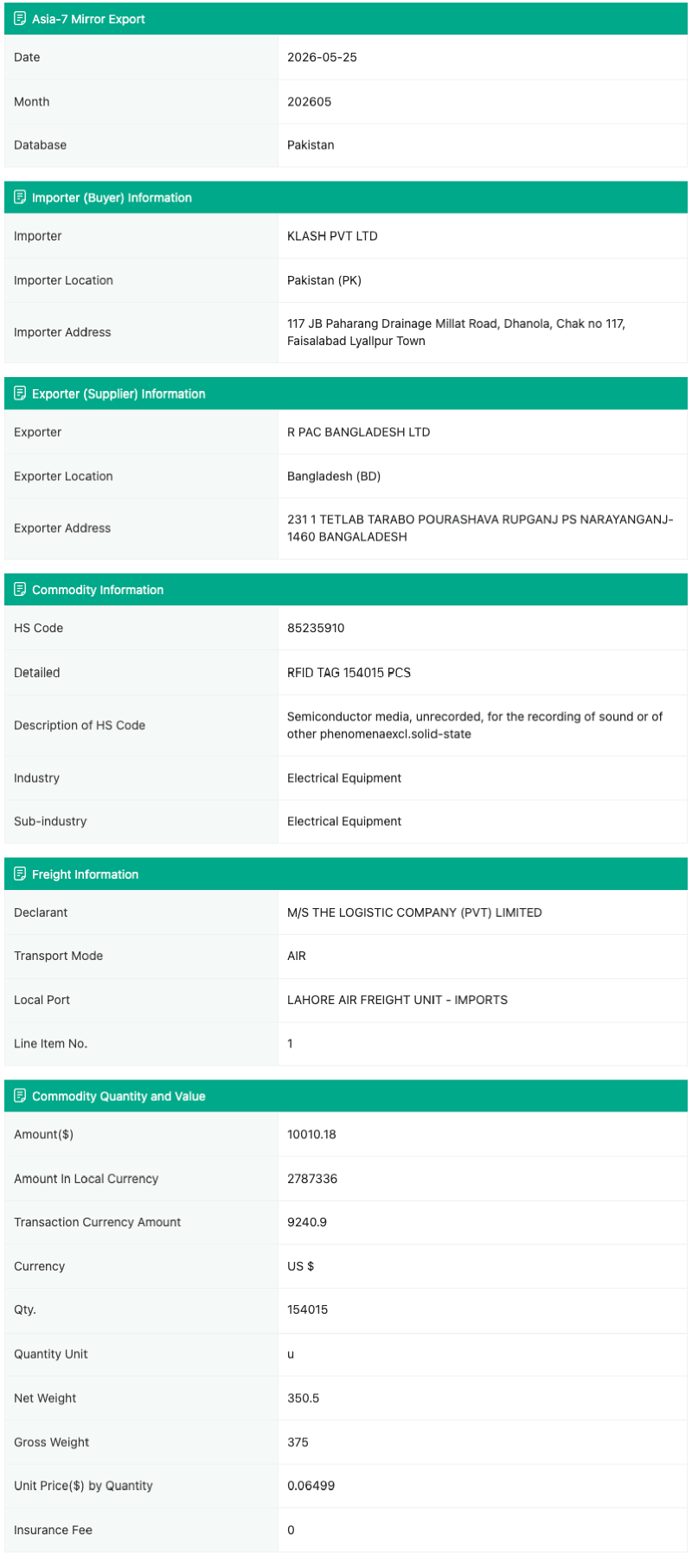
Through Blooming's trade intelligence platform, users can access detailed shipment records, importer and exporter information, product descriptions, HS codes, trade values, shipment dates, countries of origin and destination, ports, and other key trade indicators.
Blooming helps businesses:
Identify verified importers and exporters.
Discover new buyers, suppliers, and distributors.
Monitor competitor trading activities.
Track product demand and market trends.
Analyze global supply chains.
Evaluate market entry opportunities.
Generate qualified international sales leads.
Support data-driven export and sourcing decisions.
Whether you are a manufacturer, exporter, importer, trading company, logistics provider, consultant, or market researcher, Blooming's Asia customs database delivers valuable market intelligence to support international business growth.
Frequently Asked Questions
What countries and regions are included in Blooming Asia 7 Regions customs data?
Blooming Asia 7 Regions customs data covers Hong Kong SAR, Macao SAR, Taiwan Region, South Korea, North Korea, Bangladesh, and Mongolia.
What information is included in customs records?
Depending on the market, customs records may include shipment date, HS code, product description, importer name, exporter name, destination country, origin country, port information, quantity, weight, trade value, and additional transaction details.
How can customs data help find buyers?
Businesses can identify companies actively importing products within target markets, analyze purchasing frequency, evaluate shipment volumes, and generate highly targeted prospect lists for international sales development.
Which industries benefit most from Asia customs data?
Industries that commonly benefit include electronics, semiconductors, machinery, automotive, mining, chemicals, textiles, apparel, pharmaceuticals, consumer goods, logistics, and international trade services.
Why is Hong Kong customs data important?
Hong Kong is one of the world's largest re-export and logistics hubs. Customs data provides valuable visibility into regional supply chains, international sourcing activities, and trade flows connecting China with global markets.
Why is Taiwan customs data valuable for technology companies?
Taiwan is a global leader in semiconductors and electronic components. Customs data helps businesses monitor technology supply chains, identify manufacturers, and analyze demand trends across key electronics sectors.
Why is South Korea customs data important?
South Korea is a major exporter of semiconductors, automobiles, ships, machinery, and petrochemicals. Trade data helps companies track industrial supply chains, identify business partners, and evaluate market opportunities.
Why is Bangladesh customs data widely used by sourcing professionals?
Bangladesh is one of the world's largest apparel manufacturing centers. Customs data provides direct visibility into garment exporters, textile suppliers, leather manufacturers, and sourcing networks serving global brands.
Why is Mongolia customs data important for commodity traders?
Mongolia is rich in coal, copper, gold, and other mineral resources. Customs data helps commodity traders, equipment suppliers, and investors monitor export activity and identify opportunities within the mining sector.
Conclusion
The Asia 7 Regions represent a diverse and strategically important group of markets spanning global trade hubs, advanced manufacturing economies, emerging sourcing destinations, and resource-rich exporters.
Hong Kong serves as a global logistics and re-export center. Macao connects China with Portuguese-speaking markets. Taiwan and South Korea lead global technology and semiconductor production. Bangladesh remains one of the world's most important garment manufacturing bases. Mongolia supplies critical mineral resources to international markets. North Korea offers unique insights into specialized trade flows and resource exports.
For businesses seeking international growth, customs data provides a powerful foundation for identifying opportunities, understanding market dynamics, discovering buyers and suppliers, and optimizing trade strategies.
With Blooming's Asia 7 Regions customs database, companies gain access to actionable trade intelligence that supports smarter sourcing, stronger sales pipelines, enhanced competitor analysis, and sustainable global business expansion.
Explore real import and export records across Asia 7 Regions and identify your next business opportunity.

Sample Data