
- Solution
- Trade Database
- Global
-
RCEP
- Australia Statistics
- China Statistics
- Indonesia
- Indonesia Order
- Indonesia Statistics
- Japan Importer/Exporter
- Japan Statistics
- Malaysia
- New Zealand Statistics
- Philippine
- RCEP-15 Mirror
- South Korea Import B/L
- South Korea Importer/Exporter
- South Korea Statistics
- Thailand Importer/Exporter
- Thailand Statistics
- Vietnam(VNGD)
- Asia
-
Europe
- Armenia
- British Importer/Exporter
- EU-27 Mirror
- EU-27 Statistics
- France Statistics
- Germany Statistics
- Italy Statistics
- Kosovo, Serbia
- Moldova
- Russia
- Russian Railway
- Russian Railway Domestic Trade
- Russian Railway Transit
- Spanish Importer/Exporter
- Turkey
- Turkey Order
- Turkey Transit
- Ukraine
- Ukraine Adv
- United Kingdom Statistics
- America
- Africa
- Media
- Contact Intelligence
- Get a Trial
Please Sign in to view recently saved searches
Overview of Iran
Iran is an ancient civilization with a history of over 5,000 years, historically known as Persia.
Located in Southwest Asia, Iran borders Turkmenistan, Azerbaijan, and Armenia to the north, with access to the Caspian Sea and maritime proximity to Russia and Kazakhstan across the sea. To the west, it borders Turkey and Iraq; to the east, Pakistan and Afghanistan; and to the south, it faces Kuwait, Bahrain, Qatar, the United Arab Emirates, Oman, and Saudi Arabia across the Persian Gulf and the Gulf of Oman. Owing to its strategic geographic position, Iran is often referred to as a “land bridge between Europe and Asia” and an “air corridor linking East and West.”
As an important node country along the Belt and Road Initiative, Iran has a large population and abundant energy resources. Proven reserves of oil, natural gas, copper, iron ore, zinc, and other resources rank among the world's top. With strong development potential, Iran's market purchasing power is at a mid-to-upper level among regional economies.
Basic Country Information
Iran's capital, Tehran, is located in the UTC+3:30 time zone. In 2023, Iran abolished daylight saving time and now adopts Iran Standard Time (GMT+3.5) year-round.
The official language is Persian (Farsi). Turkic languages are also used, mainly in five northwestern provinces, while Arabic is spoken primarily in Khuzestan Province.
Iran is a country with strong religious traditions. Women are required to wear a chador or long coat covering the body when going out, including foreign female visitors. Handshakes between men and women are generally prohibited. In some areas, including Tehran, public buses are physically divided by gender, with separate boarding and seating areas. Female-only taxis are marked accordingly and do not accept male passengers.
Iranian dietary habits mainly feature grilled foods. Alcoholic beverages, pork, and scaleless fish are prohibited. Interfaith marriage with non-Muslims is not permitted. Urban lifestyles are relatively more Westernized.
Iran follows a five-day workweek, with Thursday and Friday as official rest days. However, many private companies operate on Thursday mornings. Iran observes a total of 26 public holidays annually.
Economic Growth
According to Iran's Statistical Center (calculated in Iranian rials), Iran's economic growth rate for fiscal year 2023/24 reached 5.7%. World Bank data show that Iran's GDP in 2023 was USD 401.5 billion, with GDP per capita at USD 4,502.5, representing a 4.2% increase.
GDP Structure
Based on the latest data from Iran's Statistical Center, in fiscal year 2023/24, agriculture, crude oil, industry & mining, and services accounted for 4.1%, 16.2%, 24.9%, and 53.9% of GDP respectively.
Oil and Natural Gas Industry
Iran is rich in oil and gas resources, holding 11.4% of the world's proven oil reserves, totaling 157.8 billion barrels, ranking fourth globally. However, its oil recovery rate is approximately 27%, significantly below the global average.
Leveraging its natural resource advantages, Iran's petrochemical industry has grown rapidly and is one of the pillars of the national economy and a major source of foreign exchange earnings. The sector is dominated by state-owned enterprises, including the National Iranian Oil Company (NIOC), National Iranian Gas Company (NIGC), National Iranian Oil Refining and Distribution Company (NIORDC), and National Petrochemical Company (NPC).
In 2023, Iran's crude oil exports reached approximately 1.3 million barrels per day, nearing pre-sanctions levels, while oil production stood at around 3.2 million barrels per day, making Iran the third-largest oil producer within OPEC. Iran produces over 350 types of petrochemical products and exports them to more than 30 countries and regions across Asia, Europe, and South America. Currently, 56 petrochemical plants are in operation, producing 54 million tons annually, with total investments of USD 53 billion.
Iran is the world's third-largest natural gas producer, accounting for 5.1% of global output. In 2023, daily production exceeded 1 billion cubic meters, equivalent to 6 million barrels of oil. Iran's domestic gas pipeline network exceeds 36,000 km and is expected to reach 45,000 km by 2025.
Mineral Resources
Iran is one of the most mineral-rich countries in the world and is often referred to as a “global mineral museum.” According to the Geological Survey and Mineral Exploration Organization of Iran, the country possesses 81 types of minerals with proven reserves totaling 55 billion tons, ranking among the world's top ten mineral-rich countries.
Iran currently exploits 56 types of minerals, with annual output of 150 million tons, accounting for 0.55% of total reserves and 1.2% of global mineral production. Zinc reserves total 230 million tons, ranking first globally; copper reserves stand at 3.3 billion tons (about 4% of global reserves), ranking third; iron ore reserves total 4.7 billion tons, ranking tenth globally.
Other proven reserves include coal (2.1 billion tons), chromite (15 million tons), manganese (3.6 million tons), titanium (250 million tons), uranium (5,000 tons), gypsum (1.7 billion tons), limestone (7.2 billion tons), decorative stone (3 billion tons), building stone (3.8 billion tons), alunite (1 billion tons), phosphate (16.5 million tons), feldspar (1 million tons), silicon (2 million tons), asbestos (70 million tons), and perlite (17.5 million tons). Copper, zinc, and chromite ores are particularly high-grade, with average contents of 8%, 20%, and 45% respectively. Iran also possesses reserves of gold, cobalt, strontium, molybdenum, boron, kaolin, bentonite, fluorite, dolomite, mica, diatomite, and barite. In March 2023, Iran announced the discovery of lithium deposits.
Iran's annual mineral output is valued at approximately USD 20 billion, with domestic consumption and exports accounting for roughly half each. From March 21, 2023 to January 22, 2024, mineral exports totaled USD 11.13 billion, up 10% year-on-year. Steel exports reached about USD 4 billion, copper products exceeded USD 1.22 billion, and aluminum exports surpassed USD 740 million. In Iranian year 1402 (March 21, 2023 to March 19, 2024), Iran imported USD 7.3 billion worth of mineral products, up 35% year-on-year.
The mining and industrial sectors are overseen by the Ministry of Industry, Mine and Trade (MIMT), with major affiliated organizations including IDRO, IMIDRO, ISIPO, TPO, Iran International Exhibition Company, ICCIM, National Iranian Copper Industries Company, IRALCO, and Mobarakeh Steel Company.
Agriculture
According to Iran's Ministry of Agriculture, during Iranian year 1402 (March 2023–March 2024), agricultural exports amounted to USD 6.2 billion, down 19.4% year-on-year, while imports reached USD 17.3 billion, down 5.6%, resulting in a trade deficit of USD 11.1 billion, narrowing by 15.5%.
Major agricultural exports include pistachios, apples, dates, tomatoes, and milk powder, with Iraq, the UAE, Russia, and Afghanistan as key destinations. Major imports include corn, soybeans, vegetable oils, rice, and soybean meal, sourced mainly from the UAE, Turkey, Russia, the UK, and the Netherlands.
Saffron is a signature Iranian agricultural product, accounting for 90% of global output. In 2023, Iran exported saffron worth over USD 207 million to 55 countries and regions, down 15.7% year-on-year. Key destinations include the UAE, China, Spain, Afghanistan, Qatar, and Italy.
Trade Agreements
Since 1979, Iran has signed 138 trade and tariff agreements with 69 countries, 16 of which involve its top 30 trading partners. Iran has concluded four or more agreements with Tunisia, Syria, Kazakhstan, Algeria, Kyrgyzstan, Armenia, Cuba, and Tajikistan.
Iran signed its first free trade agreement with Venezuela on March 15, 2005. Preferential trade agreements with Malaysia, Nigeria, Turkey, Indonesia, and Pakistan under the D-8 group took effect on July 1, 2016. Iran signed an FTA with Syria in 2011 and a preferential trade agreement with Lebanon in 2016. In December 2023, Iran formally signed a free trade agreement with the Eurasian Economic Union (EAEU), under which 87% of goods will enjoy zero tariffs.
Bilateral Investment Treaties & Tax Treaties
Iran has signed bilateral investment treaties with 52 countries and double taxation avoidance agreements with 42 countries, including China, Germany, France, Italy, Russia, Turkey, and many others.
Merchandise Trade
Due to U.S. sanctions, Iran's foreign trade partner diversification remains limited. According to Iranian customs data, over 80% of Iran's total trade volume is concentrated among its top 10 trading partners, namely China, the UAE, Turkey, Iraq, India, Pakistan, Russia, Oman, Germany, and Afghanistan.
In fiscal year 2023/24, Iran's top export destinations were China, Iraq, the UAE, Turkey, and India, while its main import sources were the UAE, China, Turkey, Germany, and India.
Approximately 80% of Iran's exports are related to petrochemical, oil, and mineral products. Major non-crude exports include methanol, metal ores, polyethylene, urea, bitumen, pistachios, saffron, nuts, iron ore, construction materials, leather, carpets, fruits, dried fruits, and caviar. About 70% of imports consist of agricultural products and machinery, including industrial equipment, raw materials, food products, medical devices, vehicles, chemicals, rice, soybeans, telecommunications equipment, meat, bananas, beverages, and tobacco.
In fiscal year 2024 (March 2024–March 2025), Iran recorded a trade surplus of USD 26.8 billion, up USD 5.8 billion year-on-year. The balance of payments surplus reached USD 13.8 billion, while GDP growth slowed to 2.8%.
According to Eurostat, Iran–EU trade reached EUR 3.1 billion in the first ten months of 2025, indicating stable albeit limited trade ties despite sanctions. Germany remains Iran's largest EU trading partner.
Blooming Iran Trade Data
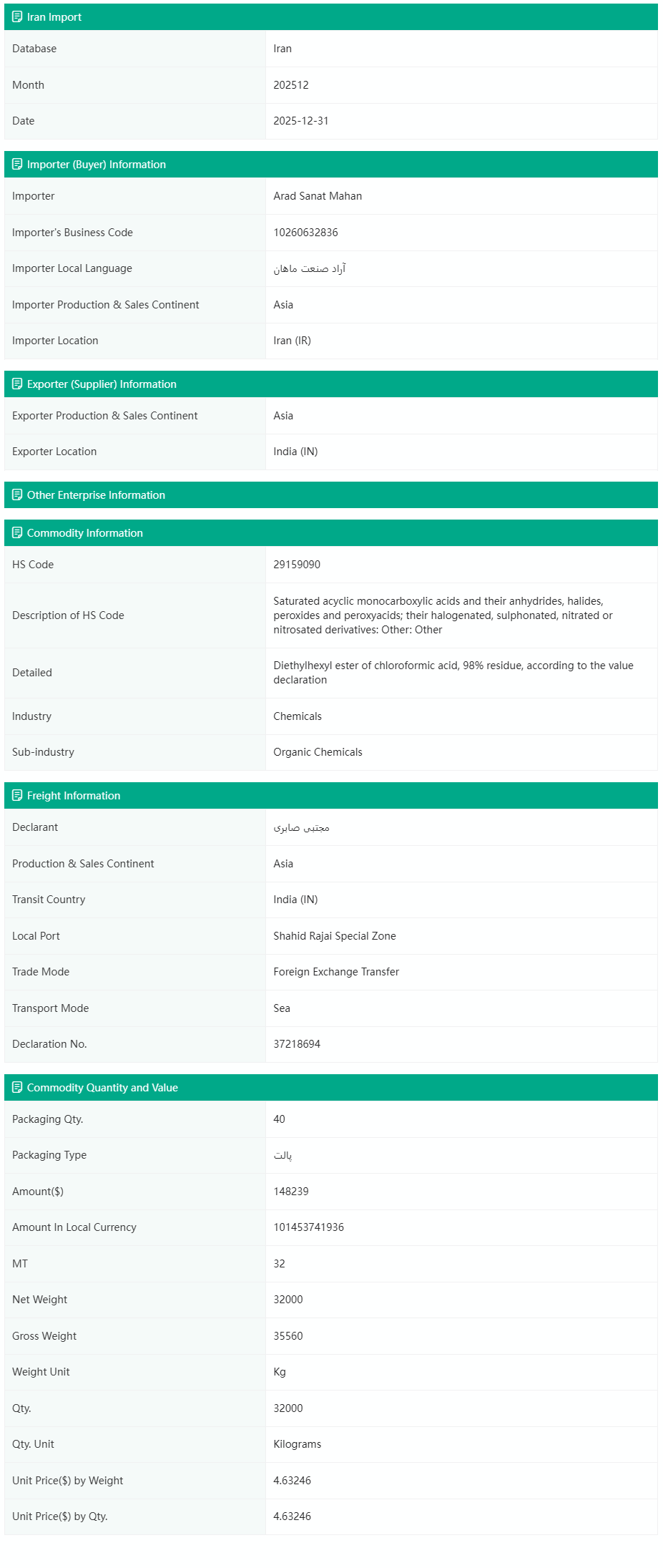
Blooming Iran Trade Data has been updated since 2024 and continues to be updated on an ongoing basis. The data covers importer information, product classifications, shipment details, and comprehensive trade volume and price indicators, including value, local currency value, weight, quantity, unit price, and packaging quantities.
Blooming Iran Trade Data helps identify exporters that continue to supply the market, assess price trends and fulfillment risks, uncover overlooked but persistent import demand, identify effective transit markets and active buyers, and reduce risks associated with blind market expansion.
Do you want to discover real, ongoing import demand in Iran that is often overlooked? Are you seeking to identify consistent buyers and reliable trading routes in the Iranian market?
Sample Data

Schedule a demo to see how real trade data reveals active import demand in Iran. You can also start a free trial to explore buyers, products, and trade flows firsthand.